
Coaching a team from customer problem to AI product launch
Background
MAVEN is the AI assistant inside The Martec, an employer branding platform used across industries including enterprises in pharma, technology and insurance. Customers knew it as a writing tool. It could also answer harder questions, such as which open roles have no employee content behind them, but only when one of our team wrote the prompts and walked the customer through the result.
Context
Customers used MAVEN for intelligence only after their customer success manager taught them one-to-one, which could not scale. I set a vision for Skills with two purposes. First, as a concept, Skills remind customers that they can use MAVEN for intelligence as well as writing, which is why they sit on MAVEN's home screen. Second, each skill then enables them to do one specific job, such as building a candidate persona before briefing a recruiter. The aim: every customer gets expert-grade answers on their own, whenever they need them.
I managed a product manager and a senior designer who did the hands-on work. As the product leader, I set the direction, chose the method and coached them through it.
Process and actions
Set the vision. I wrote the strategy for Skills including a PRFAQ. I also set the bar for what counts as a skill: it has to give customers something they could not get by typing a good prompt into MAVEN.
Prioritised problems before skills. The team had planned a feature survey. I replaced it with workshops built on business problems themed from 12 customer calls. More than 20 ideas became 3: Identify Content Gaps, Candidate Persona and Brand Localizer.
Held the scope. When discovery expanded into projects and a knowledge centre, I separated the two problems and cut both from the first release.
Coached the research. I had the designer rank the problems before showing customers a prototype, then questioned the assumptions each test had to prove. The designer tested the prototype in 7 customer interviews. Trust was the main blocker: customers "trust but verify". That shaped the UI: visible steps, sources and a confidence check.
Set the quality bar before launch. Evals on real usage need a live product. Until then, I had each skill define what good looks like up front. Sales and CS experts set that standard, and each prompt version ran on real customer data and was reviewed against it.
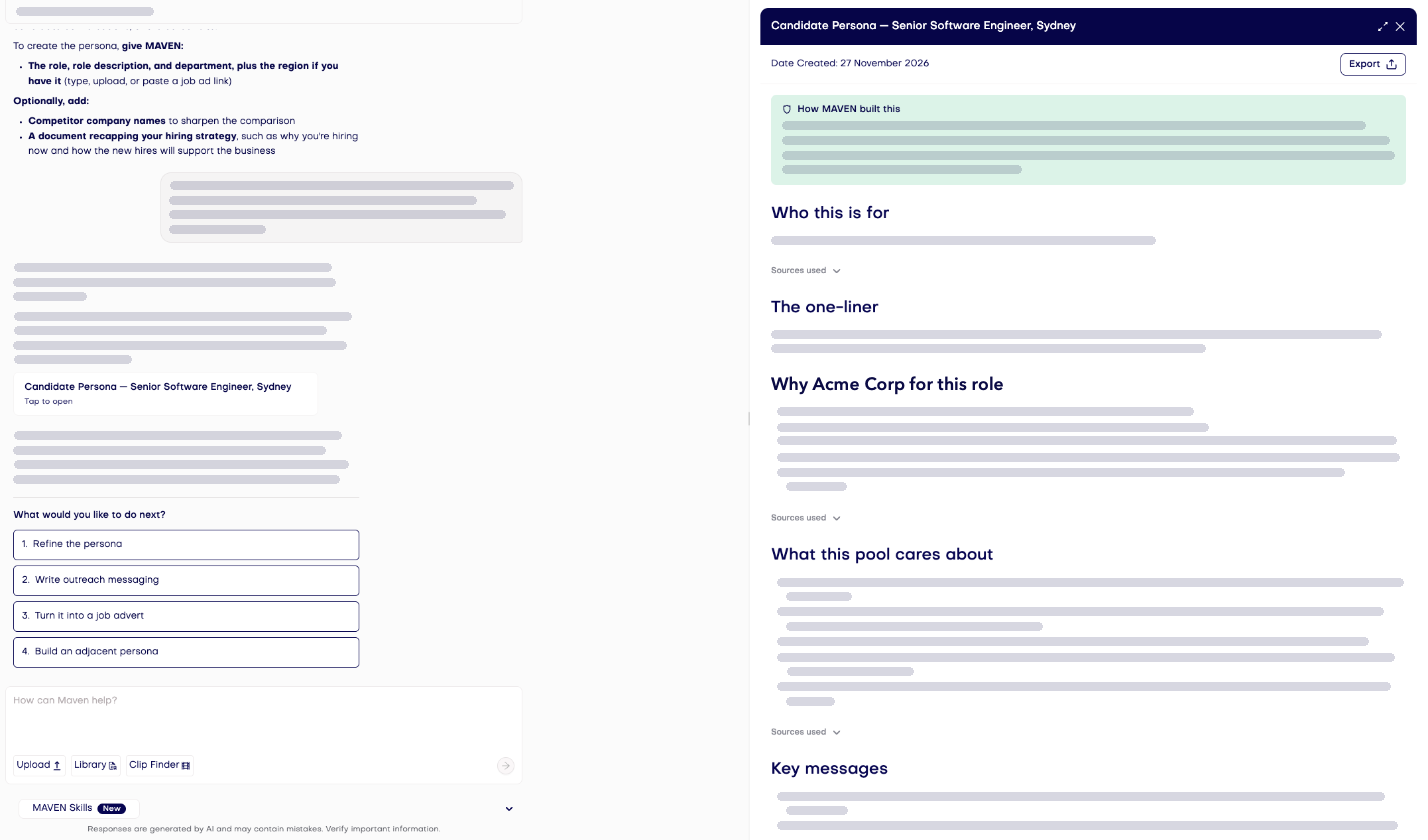
Candidate Persona in MAVEN, with the content replaced by placeholders.
Outputs & Impact
Three skills launched to all customers in November 2026. In customer testing, a persona card that took one team 2 to 3 days by hand came back in under two minutes.
From reactive to proactive content. Teams were creating content only after hiring was already struggling. A recruitment marketing lead at a global insurance broker, testing Identify Content Gaps: "I just can't wait for this to go live … This would help us become more proactive."
Recruiter support for every role. One employer brand specialist built a persona card by hand and found "it was so time consuming that I never did it again." After testing Candidate Persona: "this took me, what, less than two minutes?"
New markets without the agency bill. Customers told us localising their brand for a new market took months of paid research. A talent marketing lead at a global pharma company called Brand Localizer "super helpful, and … cost savings."
Answers that match the expert's own. The day before launch, the global employer brand lead at a customer engagement software company, watching Candidate Persona run on their own roles, said: "It literally is saying stuff that … I literally wrote down the other day."
My role was to set the problem, the scope and the quality bar. The team built the skills, and customers got answers to problems they had named themselves.